Over at Roman Catholic Spiritual Direction blog, my better known blogging colleague, Dan Burke, wrote a very good piece, titled, Can I trust Thomas Merton? which I think you ough all to read. Here's an excerpt:
Following another Catholic writer (Anthony E. Clark), Dan made an useful distinction between the earlier published works of Merton - which are orthodox - and his later works - which are not as much. Discussing Merton works, specially his later works in which he attempted to "bridge" Oriental mysticism with Catholicism is a complex endeavor. I myself prefer to read his journals where he was able to "unwind" more freely, and in which it was obvious he remained at heart a Catholic Christian. As I pointed out seven years ago when I quoted from an entry in Merton's journal dated June 26, 1965:My advice? The Church is in no way lacking in solid and perfectly trustworthy writings on the spiritual life. I personally don’t know why anyone would want to carefully sift through this kind of literature when it is clear that Merton had serious issues even in during the his orthodox period. It seems a bit like sifting through the refuse at the back of a good restaurant. You will no doubt find much that is of nutritional value, but why not just go take your seat at the table for the best and purest meals available? I would encourage you to stick with the spiritual doctors of the Church. To name a few, the writings of St. Teresa of Avila, St. John of the Cross, St. Catherine of Sienna and St. Francis de Sales will more than meet your needs for spiritual guidance and you need not worry that you might be led down a path that leads away from the Heart of the Church.
PS: I recognize that many have found that through Merton’s writings, they have grown to more fully love and serve Christ. My thoughts here don’t in any way deny that reality or possibility. My intent here is to answer the question asked by the reader. The fact that God uses many means and instruments, including very flawed instruments, to lead people to Himself is assumed and appreciated in a very personal way.

The Feast of the Sacred Heart was for me a day of grace and seriousness. Twenty years ago I was uncomfortable with this concept. Now I see the real meaning of it (quite apart from the externals). It is the center, the "heart" of the whole Christian mystery.I see nothing in Merton's subsequent writings where he recanted from this Theocentric and Christocentric perspective.
There is one thing more - I may be interested in Oriental religions, etc., but there can be no obscuring the essential difference - this personal communion with Christ at the center and heart of all reality, as a source of grace and life. "God is love" may perhaps be clarified if one says that "God is void" and if the void one finds absolute indetermination and hence absolute freedom. (With freedom, the void becomes fulness and 0 = infinity). All that is "interesting" but none of it touches on the mystery of personality in God, and His personal love for me. Again, I am void too - and I have freedom, or am a kind of freedom, meaningless unless oriented to Him. (Source)
The subject of Thomas Merton's ultimate allegiance surges in cycles in the Catholic blogosphere. Most treatments are charitable and commendable, but few allow Merton to speak for himself. I say we should let him.
What do you all think?


 The book’s religious sensibility is thoroughly Gnostic, in a number of ways. It is, for one thing, simply saturated in imagery and concepts drawn from the Gnostic systems of late antiquity, and its narrative form—its incontinent mythopoeia, its rococo excesses, its figural syzygies and archons and aeons (or whatever one might call them)—has all the occult grotesquerie of authentic Gnostic myth. More to the point, its entire spiritual logic is one of “gnosis”: a saving wisdom vouchsafed through an entirely private revelation; a direct communication from a mysterious source that is also one’s own deepest ground, but from which one has become estranged; a truth attained not through the mediation of nature or culture, and certainly not through the moral “law,” but solely in the apocalyptic secrecy of the illuminated soul.

 John is the voice, but the Lord is the Word who was in the beginning. John is the voice that lasts for a time; from the beginning Christ is the Word who lives for ever.

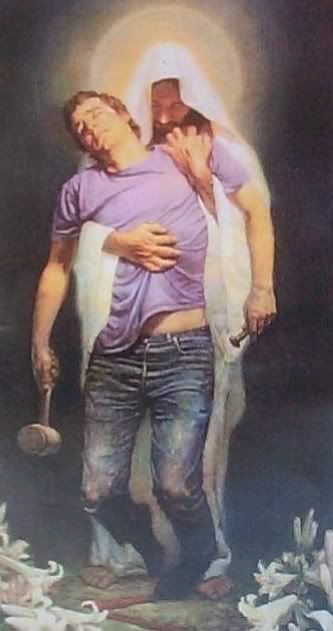 “How many times will I have to forgive my brother when he offends me?” Peter’s question is always current for a Christian: Where is the limit of our forgiveness? Do we have to forgive the offences always anew and without measure?
 The voice of one crying in the wilderness: Prepare the way of the Lord, make straight the paths of our God. The prophecy makes clear that it is to be fulfilled, not in Jerusalem but in the wilderness: it is there that the glory of the Lord is to appear, and God’s salvation is to be made known to all mankind.

